
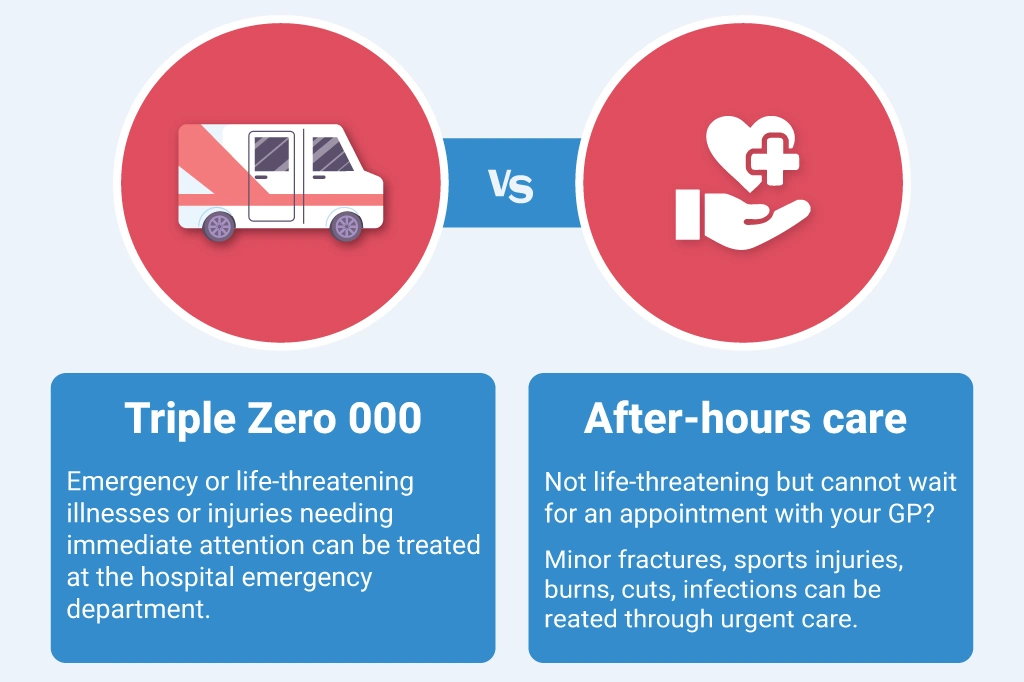
When to Call 000 vs. After-Hours Care
Sometimes health issues are inconvenient because they appear outside of working hours. It can be quite a challenge when you feel something is wrong with your health late at night and aren't sure what to do. Should you dial 000 or contact after-hours care?
This is an elementary guide. In the case of a serious, time-critical, or life-threatening emergency, the first thing to do is to call Triple Zero 000. If the condition is such that you cannot wait to see your regular GP and you have no other option, then you can go for after-hours GP care, telehealth, home visits, or Medicare Urgent Care Clinics (UCCs).
At 13CURE, we want you to know where to go if you need medical help outside of hours. Our goal is to assist you in making safe decisions and keep your regular GP informed of your continued care. We operate strictly under our after-hours urgent care protocols, which prioritise patient safety above all.
When to Call Triple Zero 000
Call 000 without hesitation if someone's life is in danger, there is a serious injury, or you find the situation unsafe to wait for aid. The operator will link the required services (Ambulance, Police, or Fire) and keep the line open until they arrive.
If you are unsure, think about:
- Is a person severely hurt or in danger?
- Is life or property in danger?
- Have you seen a heavy accident?
If you answered yes to any of these, call 000 right away. Early action in an emergency is always safer.
If you feel this is not a 000 case but still requires some advice, Healthdirect can be contacted at 1800 022 222 for free nurse support. They will assist you in deciding the next step or direct you to exemplary service.
Check our areas we cover page to see if after-hours doctors are available in your location.
When Is After-Hours Care Appropriate
After-hours care is intended for non-life-threatening issues that cannot be postponed until the next day. It includes times when the majority of GP clinics are closed, such as:
- From Monday to Friday, 6 pm to 8 am
- On Saturday from 12 pm onwards
- All day Sunday and public holidays
You are allowed to:
- Schedule a telehealth consultation for medical advice
- Attend an after-hours medical centre
- Arrange for a doctor to come to your home (in certain areas)
- Visit a Medicare Urgent Care Clinic (UCC)
Medicare UCCs are walk-in clinics where patients with urgent but not emergency conditions can go. They offer bulk billing for Medicare cardholders and have extended hours. These clinics are a means of lessening the pressure on hospitals while providing quick access to care.
What Is After-Hours GP Care Good For
After-hours services provide different options for choosing the most suitable one for your case.
- Telehealth is excellent when you need quick advice, have mild symptoms, or want to stay home.
- Clinic visits are a better choice when you require the doctor to do some physical checks.
- Home visits can assist you if you have trouble with transportation or mobility.
Understanding the role of urgent care can help prevent hospital overcrowding. The doctor who visits you after hours can also send the notes to your regular GP, helping maintain the same level of care and reducing the number of times you need to be assessed the following day.
What to Do at Night
- Study the condition. If the situation is dangerous or time-critical, dial 000 right away. If it is unsafe to wait, you should still be able to call 000.
- Decide what is most convenient for you. Telehealth is the best and most modern option if you lack medical advice. If you decide that seeing a doctor face-to-face would suit you better, then go to an after-hours clinic or ask for a visit at your place. If you require urgent care (but not an emergency), then a Medicare Urgent Care Clinic will be the right place to go.
- Prepare your information. Ensure your phone contains your name, date of birth, phone number, location, Medicare card number, and GP's name. This is very handy when booking or checking in and saves time.
- Be prepared for waiting times. Quite a few people may be free during the night, on weekends, and on public holidays. A telemedicine session will usually take less time, while local clinic or home visits will depend on availability in your area.
- Next-day treatment follow-up: Write down the directions of the doctor you met in the after-hours session and schedule a visit with your regular GP. This will significantly help reduce the number of checks and make the flow of your care continuous.
Telehealth is the First Choice
Frequently, telehealth keeps you from going out at a time that is not convenient for you. So, you can see a doctor, be guided, and get a written follow-up of steps without venturing out of your home. If your symptoms align with conditions suitable for home treatment, you can safely book a visit.
To maintain a good professional level, doctors comply with the rules set by the Medical Board of Australia. Thus, they check your ID, record the session, and issue you explicit and elaborate instructions for what you should do next. Besides, if a doctor needs to see you face-to-face to examine you, he will help you visit the clinic or UCC.
Besides, telemedicine removes the hours of travel and the queuing process, which is an excellent benefit for those living in rural areas and people needing immediate reassurance. If you want to book quickly, at home or on the go, go for telemedicine after the sessions via our online booking platform.
Related articles
Need a doctor after hours
Our team is available 24/7 for bulk billed home visits across Australia.