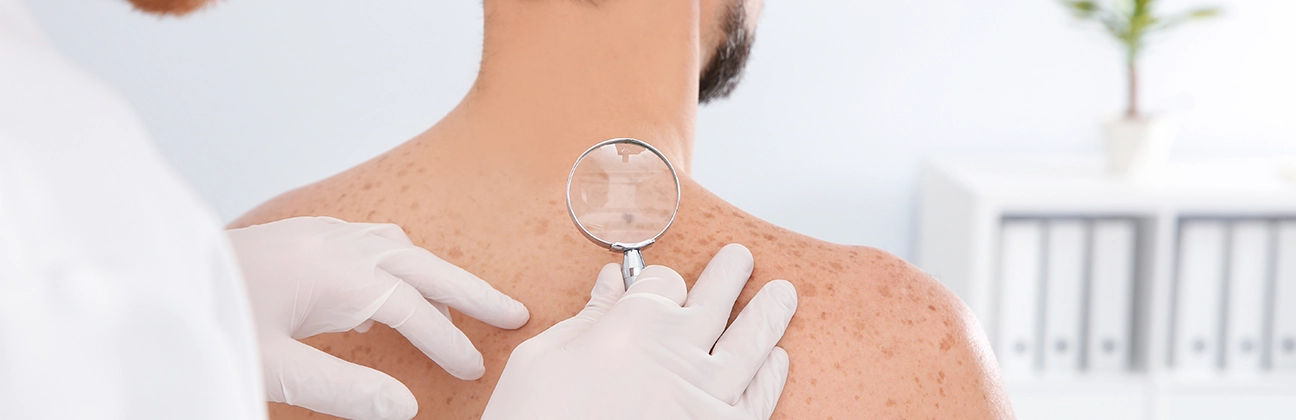
Two in three Australians are diagnosed with some form of skin cancer before they turn 70. Most are highly treatable when caught early, and the ones that are not tend to be the ones nobody noticed in time. The useful knowledge is not a memorised list of what cancer looks like - it is knowing your own skin well enough to spot what has changed. If a spot has started bleeding, become painful or looks infected, an after-hours GP consultation or a telehealth appointment can advise you, though a proper skin examination belongs with your regular GP in daylight.
The three types, and how common each one is
The proportions surprise most people. Cancer Council puts basal cell carcinoma at roughly two in three skin cancers, squamous cell carcinoma at about one in three, and melanoma at around one in a hundred. Melanoma is by far the most dangerous and by far the least common.
Basal cell carcinoma (BCC)
A pink, pearl-like lump, flat or raised, or a shiny scaly pink patch. It can itch or bleed, and often heals over then flares again - that cycle is the giveaway. BCCs grow slowly and rarely spread, but they keep growing locally and are easiest to treat small.
Squamous cell carcinoma (SCC)
A thickened scaly lesion, a fast-growing pink lump, or a red crusted spot. Often tender, sometimes bleeds. SCCs grow faster than BCCs, and those on the head, neck, lips or ears - or in anyone immunosuppressed - are more likely to spread, so not ones to sit on.
Melanoma
Starts in the pigment cells, and is the form most likely to spread, which is why early detection changes the outcome so dramatically. It can appear in an existing mole or as an entirely new spot, and not only on sun-exposed skin.
The ABCDE guide for melanoma
Cancer Council's checklist for assessing a mole:
- A - Asymmetry: the two halves do not match
- B - Border: the edge is irregular or spreading
- C - Colour: blotchy, with several colours such as black, blue, red, white or grey
- D - Diameter: the spot is getting bigger
- E - Evolving: it is changing or growing
One more test is worth adding, often called the ugly duckling. Your moles tend to resemble each other, so the one that looks unlike the rest deserves attention even if it passes every letter above.
The melanomas that do not look like melanoma
This is the part most skin cancer content leaves out, and the part that costs lives. Amelanotic melanoma has little or no pigment - instead of brown or black it appears pink, red or skin-coloured, so it gets dismissed as a pimple, a scar, or nothing at all. People who have watched their brown moles carefully for years miss it entirely, because it does not match the picture in their head.
Nodular melanoma is the other. It grows outward as a firm raised lump rather than spreading flat, so ABCDE largely does not apply - it is usually symmetrical, evenly coloured and well defined. What it is instead is elevated, firm, and growing, often over weeks rather than years.
The common thread is change. Any new lump that is firm and growing, or any spot behaving differently from the rest of your skin, needs a doctor to look at it - whatever colour it is.
Why photos are not a diagnosis
Searching for skin cancer images is the obvious instinct and an unreliable method. Skin cancers vary enormously, the pictures online are almost all advanced lesions rather than early ones, and the types above look nothing like the classic examples. Research has also found smartphone apps cannot reliably detect skin cancer, and a dermatoscope in trained hands sees structure no photograph conveys. If a spot has you searching for images, that is already the answer: book the appointment.
Checking your own skin
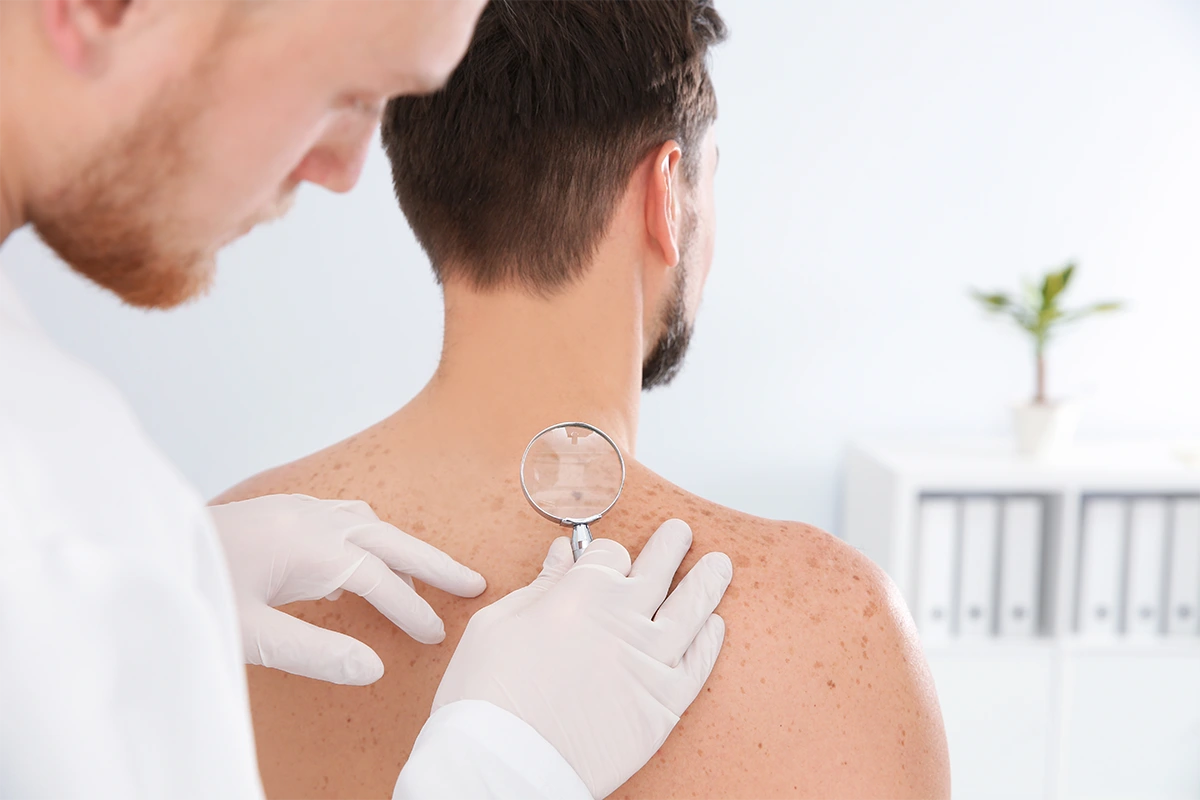
The method matters more than the frequency. Undress completely, use good light, and check everywhere - soles of the feet, between fingers and toes, under nails, and skin the sun never reaches. Use a mirror for your back and scalp, or ask someone. You are looking for new spots, moles that have grown or become notched, colour shifting from brown to black, raised lumps, rough scaly or ulcerated surfaces, and anything that itches, tingles, bleeds or weeps.
See a GP about any new mole appearing after about age 25, any mole that now looks different from the others, and anything that has changed. When in doubt, get it looked at - that is not an overreaction, it is the entire strategy.
Where to get a skin check
Your regular GP is the usual starting point and can advise whether you need routine medical skin checks. Dedicated skin cancer clinics and dermatologists also perform checks, and a GP referral is the normal route to a dermatologist. 13CURE is an after-hours service and does not provide skin checks or skin cancer treatment - a worrying spot is a daytime appointment with your own GP. Where an after-hours service helps is a lesion that has started bleeding, become painful or looks infected, and a bulk billed telehealth appointment is usually enough to decide what happens next.
What causes skin cancer
Ultraviolet radiation damages the DNA in skin cells, and over years that damage accumulates into cancer. Australia has among the highest UV levels in the world, which explains our rates. Risk is higher with fair skin that burns easily, a history of sunburn - childhood sunburn particularly - heavy sun exposure through work or sport, many or irregular moles, family history, a weakened immune system, and increasing age. Having had one BCC raises the odds of another.
How skin cancer is treated
Treatment depends entirely on type, size, depth and location, so this is only the shape of it. Most non-melanoma skin cancers are removed surgically under local anaesthetic, often by a GP with skin expertise. Some superficial lesions are treated with creams or freezing. Melanoma is excised with a margin of surrounding skin, with further investigation or specialist care depending on depth. Melanoma Institute Australia has detailed information for anyone facing a melanoma diagnosis.
The pattern is the same throughout: found early, most skin cancer is removed and done with. Found late, it becomes a far bigger undertaking.
|
Important: this article is general information and cannot tell you whether a spot is cancer. Nothing here substitutes for examination by a doctor, and no product, app or photo comparison can diagnose skin cancer. 13CURE does not provide skin checks, diagnosis or treatment of skin cancer. |
|
For an after-hours concern about a bleeding, painful or infected lesion,book a consultation online or start a telehealth booking. Coverage is listed on the areas we cover page, and eligibility on the bulk billing GP page. |