
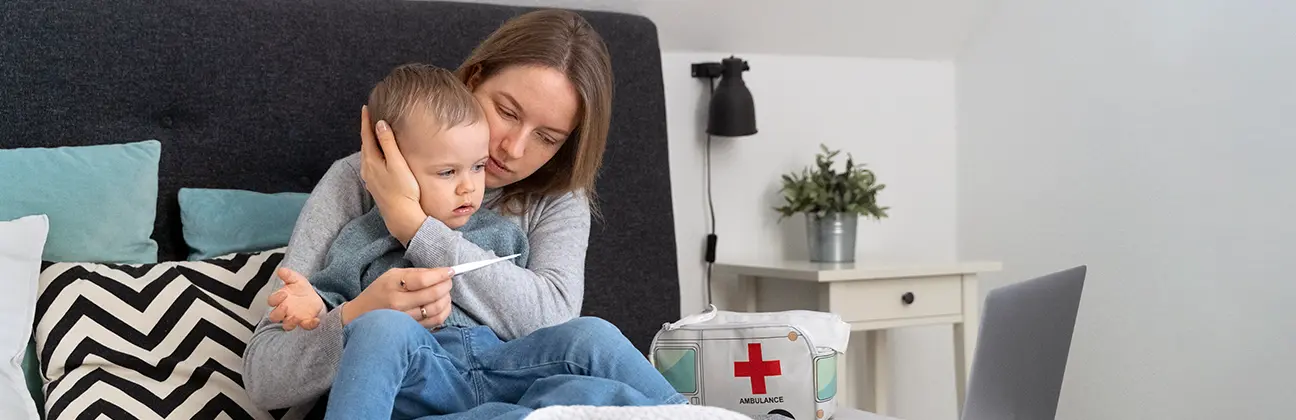
Understanding Fevers in Early Childhood: What Parents Need to Know
Fevers are common in early childhood, but they can be very worrying for parents and caregivers and may be a cause for concern. If you have an infant or newborn, or you're expecting one, it's best to educate yourself about baby fever symptoms and when to seek medical attention. This way, you know how to act when your child's temperature spikes.
1. What is a Fever, and How Should I Take My Baby's Temperature?
A fever is an indication that your baby's immune system is fighting off a virus or infection. When the body detects a virus or bacteria, it raises its core temperature to kill the invader.
Fevers, therefore, are not usually a cause for concern in themselves and may not require professional medical attention.As your baby's immune system is still immature, they'll probably get several fevers in their first year, and each is most likely just a sign that they're fighting off a cold or minor infection.
However, fevers can make your child uncomfortable, and it's essential to monitor their temperature and how they are feeling. It is also critical to look out for other baby fever symptoms that may indicate a more serious infection.
A baby's fever is classed as any temperature above 37.5 degrees Celsius in an infant. A high fever does not necessarily indicate a more serious problem (some children naturally get very high fevers whenever they're ill). Still, a fever in a young baby should always be investigated. Fever over 38.3 degrees Celsius in young children can sometimes lead to a febrile convulsion (see part 4 of this guide for more information).
If your baby feels particularly warm to the touch or has other symptoms such as irritability, excessive crying, a runny nose, a rash, vomiting, or excessive sleepiness, youshould take their temperature.
You can do this with an infrared forehead thermometer, an ear thermometer, or a digital thermometer under the arm or tongue. It's not recommended to check your baby's temperature rectally, and using old-fashioned glass mercury or alcohol thermometers is not advised for young children, as they can cause injury if they break.
Whichever method you choose, you should stay consistent. A temperature reading taken externally under the arm or on the forehead may be up to 0.6 degrees Celsius lower than an oral temperature reading.
How to Treat Fever in an Infant
If your baby has a fever but is otherwise eating, drinking, and sleeping well and doesn't seem to be in distress, you don't need to take any action. It's not necessary to treat the fever; only the cause of the fever. Sometimes babies may have a fever for a day or two with no other symptoms, and it will resolve without treatment.
However, you must seek medical advice for any fever in a baby below three months old. If your baby is above three months old and seems unwell, there are a few things you can do to make them more comfortable:
- Dress them in light clothing and don't wrap them up too warmly in bed, as this can make it difficult for the body to regulate temperature.
- Sponging their forehead with warm water can help them to cool down, but don't use cold water or put them in a tepid bath, as this can make them too cold and can be dangerous.
- Keep your baby hydrated by offering frequent breast feeds, or extra water for babies who are formula-fed or already eating solids.
- Baby paracetamol can help reduce a fever. Remember that baby paracetamol is not suitable for babies born prematurely, babies of a low birth-weight, or for babies under one month old. Always check the directions carefully for dosage instructions.
- Babies over six months old can be given ibuprofen, but it can irritate the stomach, so it should always be given with food. Ibuprofen can worsen symptoms of some illnesses, such as chickenpox, so it's usually best to try paracetamol first unless advised otherwise by your doctor.
- Continue monitoring your baby's symptoms and temperature regularly, but you don't need to wake them to check their temperature or give medication.
When to Seek Medical Treatment for Baby Fever
Call a doctor for advice if your baby is under three months old and has any fever, or has any of the following symptoms alongside a fever at any age:
- Rash
- Medications are not working to bring down the fever
- Frequent vomiting or diarrhoea
- Refusal to drink
- Seems unusually drowsy or pale
- Has signs of dehydration such as a sunken fontanelle, dry mouth, fewer wet nappies, or no tears when crying
- Is crying inconsolably or seems to be in pain
- Have any problems with their breathing
- Has a fever of 40 degrees Celsius or over
- Has had a febrile convulsion (see part 4)
- Seems to be getting worse rather than better
- Has had a fever for more than 48 hours.
It's always best to trust your instincts. If you're worried about your child, seek medical advice and get them checked over by a doctor just to be sure.
What is a Febrile Convulsion?
Febrile convulsions, or seizures, can be triggered by a fever in a baby or any young child, usually under the age of five. Instances peak at around age two, and occur in around 2 - 5% of young children. If your child has experienced one febrile convulsion, they're around 40% more likely to experience a recurrence. They're also more likely to experience this if you have a family history of febrile seizures.
During a febrile seizure, your child will lose consciousness, experience convulsions, and may shake uncontrollably, go stiff, or twitch. In some cases, their eyes may roll back in their heads. Other children may lose consciousness but do not seem to convulse or shake.
Febrile convulsions usually last for a few minutes before your child regains consciousness. They can be very frightening, but they do not cause any long-term health problems. Despite some similarity in symptoms, these convulsions do not mean that your child has epilepsy.
If your child is having a febrile seizure, stay calm and put them gently on the floor, lying them on their side to prevent injury or choking. Do not hold or restrain your child, and remove any objects from their mouth if possible.
Time the seizure and call for medical help immediately if it does not stop after five minutes. You should also call for medical help if your baby does not seem to be recovering quickly after coming out of the seizure, or if this is the first time they have had a febrile seizure.
When a Fever is a Medical Emergency
If your baby has any of the following symptoms, you should call for medical help or take them to the hospital immediately:
- Severe vomiting and unable to keep fluids down
- Difficulty breathing or swallowing, or very rapid breathing
- Bulging fontanelle
- Is fitting or convulsing and has not been diagnosed with febrile convulsions before.
If your baby has a fever and you want a doctor to visit your home outside your GP's regular hours, contact 13CURE to arrange a home visit. We offer a range of family medical services across New South Wales, supported by a team of skilled, caring doctors.